Why Association Is Not Automatic Guilt
The Epstein Files and Why Nothing May Happen

The case of Jeffrey Epstein continues to generate public attention years after his death. Arrested in 2019 on federal sex trafficking charges, Epstein was accused of operating a network that exploited underage girls. He died in custody at a federal jail in New York while awaiting trial. The official ruling by the New York City medical examiner classified his death as suicide.
Despite that official finding, the case has remained active in the public mind because of the number of prominent individuals who had past associations with Epstein. Flight logs, contact books, and previously sealed court documents have fueled speculation about who knew what, and when. However, association alone has not equaled criminal charges in most instances.
Why More Charges Have Not Emerged
Federal prosecutions require evidence that meets a high legal standard. Prosecutors must show proof beyond a reasonable doubt for criminal convictions. While civil lawsuits brought by victims have resulted in settlements and unsealed records, criminal cases depend on documented evidence of direct involvement in illegal acts.
In addition, Epstein’s death complicated matters. As the central defendant in a major federal case, his passing halted prosecution against him personally. While investigations can continue into other potential actors, building cases without a cooperating primary defendant can be legally and practically challenging.
Sealed Records and Public Expectations
Much of the ongoing speculation centers around sealed or partially redacted court documents. Courts seal records for several reasons, including protecting victim privacy, safeguarding ongoing investigations, or complying with legal standards regarding evidence. The public often expects dramatic revelations from such files, but many documents may contain material already known or legally irrelevant to criminal charges.
Civil Accountability vs. Criminal Prosecution
Several civil suits connected to Epstein and his associate Ghislaine Maxwell have produced financial settlements and court disclosures. Maxwell was convicted in federal court in 2021 on sex trafficking-related charges and sentenced to prison. Her conviction represents one of the few completed criminal cases directly tied to Epstein’s network.
Civil proceedings operate under a lower burden of proof than criminal trials. As a result, actions that may result in civil liability do not always lead to criminal prosecution. This legal distinction often frustrates members of the public who expect broader criminal accountability.
Institutional Limits and Legal Reality
Federal investigations can take years. They require witness testimony, corroborating evidence, jurisdictional authority, and prosecutorial discretion. The Department of Justice must also weigh the likelihood of conviction before bringing charges. If prosecutors believe evidence does not meet the standard required in court, charges may not be filed.
Public skepticism remains high. Polling over the past several years has shown declining trust in major institutions, including government and media organizations. In such an environment, the absence of visible new charges can reinforce suspicion that information is being withheld, even when investigations are ongoing or evidence is insufficient.
The Brutal Truth
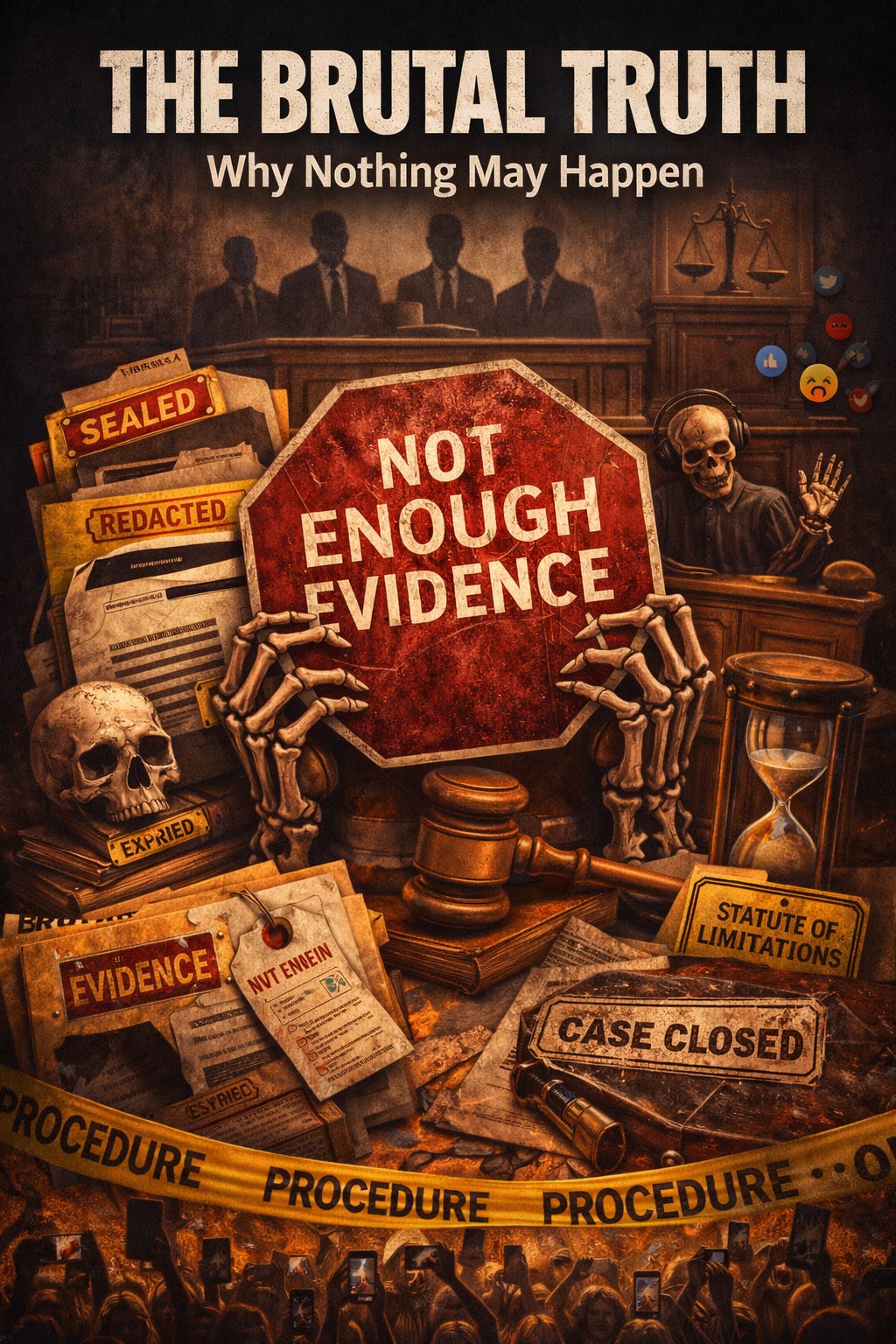
Why Nothing May Happen
Here’s why nothing may happen: evidence has to exist. Not vibes. Not suspicions. Not “his name was in a little black book.” Real evidence. Courtroom-grade. Beyond-a-reasonable-doubt evidence. If it’s weak, old, sealed, expired, or tied to a guy who’s already dead, the machine doesn’t move. That’s not a conspiracy theory — that’s how the legal engine is built.
Statutes of limitations expire. Witnesses forget. Testimony contradicts itself. Deals get sealed. Files get redacted. And the main defendant? He’s gone. You can’t cross-examine a corpse. You can’t prosecute a headline. And you definitely can’t indict a rumor.
Now here’s the part people hate: outrage is not a legal standard. Trending on social media is not admissible evidence. A contact list is not a conviction. The justice system is slow, rigid, technical, and allergic to public emotion. It doesn’t run on anger. It runs on procedure. And procedure doesn’t care how mad you are.
Does that erase the severity of what Epstein was accused of? No. It means the courtroom is not Twitter. Due process is not a crowd vote. And prosecutors don’t file charges just because the public wants a spectacle.
The real tension isn’t just about files. It’s about trust. People don’t trust institutions. They don’t trust prosecutors. They don’t trust media. They don’t trust anyone wearing a suit and using the phrase “ongoing investigation.” So when nothing dramatic happens, it feeds the suspicion that something must be buried.
Maybe it is. Maybe it isn’t. But legally speaking? If new evidence doesn’t clear the bar, the system stays still.
And that’s the brutal truth: the justice system is built to convict on proof, not pressure. If the proof isn’t there — or can’t legally be used — the show ends without the finale people were expecting.
Sources
https://www.justice.gov/usao-sdny/pr/jeffrey-epstein-charged-sex-trafficking-minors
https://www.justice.gov/usao-sdny/pr/ghislaine-maxwell-sentenced-20-years-prison
https://www.uscourts.gov
https://www.law.cornell.edu/wex/beyond_a_reasonable_doubt
https://www.law.cornell.edu/wex/civil_case
https://www.pewresearch.org
https://www.courtlistener.com
Please Like & Share 😉🪽
@1TheBrutalTruth1 FEB. 2026 Copyright Disclaimer under Section 107 of the Copyright Act of 1976: Allowance is made for “fair use” for purposes such as criticism, comment, news reporting, teaching, scholarship, education, and research.