Voters handed Democrats full control of Congress on November 3, 2026, and they did it in places few analysts thought possible.
Is Our Country Lost? The Fight for Election Integrity Is Far From Over
It’s difficult to know where this country is headed anymore. Americans are watching a political system increasingly defined by distrust, division, accusations, and questions about accountability. But regardless of which party wins or loses, one issue should concern every American: Can we trust that our elections are being conducted fairly, transparently, and honestly?
The November 3 midterm elections brought plenty of controversy, and the concerns did not end when the polls closed. Alaska’s Senate race remains under scrutiny, with Democrat Mary Peltola leading Republican Dan Sullivan while ballots are still being counted. The administration has also challenged the Alaska race in court. Mississippi’s Senate contest is separated by an extraordinarily narrow margin, with legal questions surrounding outstanding ballots and the possibility of further court involvement.
And Alaska and Mississippi are not the only places where election administration raised questions. In Westchester County, New York, a software update caused voting scanners to reject paper ballots, potentially affecting as many as 250,000 ballots. Those ballots had to be secured for later counting under a court order with representatives of both parties observing. In Ohio, a bomb threat temporarily closed a polling location, while in Georgia, voters received misleading text messages containing false information about polling locations. These incidents deserve scrutiny, even when there is no evidence that they changed an election outcome.
Florida also experienced a brief voting system malfunction that delayed some voters, while Oklahoma reported equipment problems. In Arizona, severe weather and flooding disrupted access at some polling locations in Maricopa County. None of these incidents, by themselves, establishes election fraud. But they do raise legitimate questions about preparedness, backup procedures, transparency, and accountability. Voters should not have to wonder whether their ballots were properly handled or whether every eligible vote will be counted.
Alaska deserves particular attention. The Justice Department challenged the state’s handling of a Senate race involving two candidates with the same name. A federal judge dismissed the administration’s lawsuit, and the Justice Department indicated it would appeal. That legal dispute deserves public scrutiny, but it should not be confused with proof that fraudulent votes were cast.
Then there is the other side of the problem: misinformation. A viral claim that the FBI discovered more than 20,000 fraudulent ballots in a Houston warehouse was denied by the FBI. The accompanying photographs were unrelated. If election integrity is going to mean anything, we must demand evidence rather than accept every allegation circulating online.
Americans have every right to demand answers. Election officials must be held accountable for mistakes, questionable procedures, inadequate safeguards, and failures to maintain public confidence. At the same time, accusations of fraud must be supported by evidence, investigated properly, and resolved through lawful procedures. Neither political party should receive a free pass.
Our constitutional system depends on public trust. That trust cannot be demanded. It must be earned through honest administration, transparent counting, independent oversight, and consequences when wrongdoing is established.
So, is our country lost? I don’t think anyone can answer that question with certainty.
But one thing is clear: Americans cannot afford to become complacent. We cannot simply cast our ballots, walk away, and assume everything is being handled properly. We must remain informed, watch the results, follow recounts and court proceedings, question irregularities, and insist that election officials provide answers.
And perhaps most importantly, we must remember that election integrity is not a Republican issue or a Democratic issue. It is an American issue. Our votes are the foundation of our representative government, and protecting that foundation belongs to every citizen.
Let us pray to God that Americans remain vigilant, that truth prevails, and that those entrusted with protecting our elections never forget who they serve.
Because this country belongs to its people, not to the politicians who temporarily occupy positions of power.
The Senate and House Flip
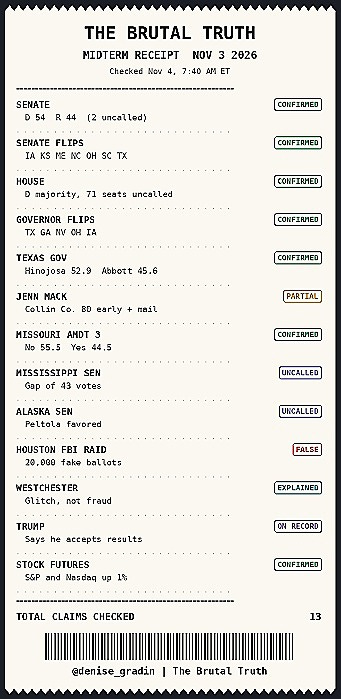
Texas, Ohio, Iowa, Kansas, South Carolina and North Carolina all moved toward Democrats at the top of the ticket. Counting is not finished. As of 7:40 AM Eastern on Wednesday, November 4, two Senate races and about 71 House races were still uncalled. What follows separates projected results from claims, and it answers the harder question: did this election damage the country?
CNN projects Democrats at 54 Senate seats and Republicans at 44, a count that includes two independents who vote with Democrats. Democrats flipped seven Republican seats: Iowa, Kansas, Maine, North Carolina, Ohio, South Carolina and Texas. In Texas, state Rep. James Talarico beat Attorney General Ken Paxton, and Paxton conceded on election night. In Michigan, Abdul El Sayed won the open seat and will be the first Muslim senator in American history. Republicans held Florida with Ashley Moody and Nebraska with Pete Ricketts, who beat independent Dan Osborn.
Two Senate races remain uncalled. In Mississippi, Republican Sen. Cindy Hyde Smith and Democrat Scott Colom were separated by 43 votes with about 96% counted. Mississippi has no automatic or candidate requested recount, so only a court could order one, and absentee ballots can arrive until November 10. Colom’s campaign says about 15,000 affidavit ballots are outstanding, a number that has not been independently confirmed. In Alaska, Democrat Mary Peltola leads Sen. Dan Sullivan, but many votes are still out.
In the House, Democrats have clearly passed the 218 seats needed for a majority. Exact totals differ by outlet because so many seats are uncalled. CNN counted 231 Democratic wins to 139 Republican wins, while NBC News projects Democrats will finish with at least 258 seats, their largest total since 1993. Treat 258 as a projection, not a count. One notable result: Republican Rep. Mike Lawler conceded New York’s 17th District to Democrat Cait Conley on election night.
Governors, Texas and the Write In Vote
Democrats flipped at least five governorships: Texas, Georgia, Nevada, Ohio and Iowa. In Texas, Gina Hinojosa defeated Gov. Greg Abbott 52.9% to 45.6% with about 96% of the expected vote counted, according to AP data. She will be the first Latina governor of Texas and its first Democratic governor since Ann Richards left office in 1995. Her lead narrowed as late votes came in, from about 16 points at the halfway mark to about 7 points by Wednesday morning, so the final margin may shift slightly but the call stands.
Other governor results carry their own firsts. Keisha Lance Bottoms won Georgia and becomes the first Black woman elected governor in American history. Aaron Ford beat Gov. Joe Lombardo in Nevada and becomes that state’s first Black governor. Amy Acton beat Vivek Ramaswamy in Ohio, and Rob Sand won Iowa. Democrats also held Maine and Wisconsin.
Write in candidate Jenn Mack Raphoon was certified for the Texas governor’s race, so her votes are being counted. No statewide write in total has been published yet. The only certified county figure found so far is Collin County, which recorded 80 votes for her: 5 by mail and 75 during early voting. That report does not include Election Day write ins. Two small county reports show single digit totals. Statewide numbers will come when Texas canvasses its results.
Ballot Measures: Missouri and Idaho Split
Missouri voters rejected Amendment 3, 55.5% to 44.5%, with all 3,214 precincts reporting. The amendment would have repealed the abortion rights measure voters passed in 2024 and limited abortion to emergencies, fetal anomalies, and rape or incest before 12 weeks.
It would also have written a ban on gender transition procedures for minors into the state constitution. Missouri is now the first state to defeat an attempt to overturn an abortion rights amendment. One distinction matters here: Missouri’s existing laws limiting gender transition care for minors stay in effect, because the vote only decided whether to add a ban to the constitution.
Idaho went the other direction. Voters rejected Proposition 1, which would have created a right to abortion until fetal viability, so Idaho’s near total ban stays in place. Taken together, the two states show that voters are defending the status quo they already have, not voting along one national line on abortion.
The Backlash: Fraud Claims, Glitches and Lawsuits
The worst fears did not come true. ICE agents were not sent to polling places, the Postal Service delivered mail ballots, and the Justice Department’s poll monitors caused no reported disruptions.
The courts did much of that work before the vote. On November 2 the Supreme Court refused the administration’s emergency request to make California set aside about 20,000 mail ballots it said came from noncitizens. Election law writers at Slate report that the Justice Department lost all 27 of its attempts to get states to hand over unredacted voter rolls.
The real problems were local and fixable. In Westchester County, New York, a software update made after testing caused scanners to reject paper ballots, affecting up to 250,000 ballots. Voters placed them in sealed bags that police escorted to a warehouse to be counted with both parties watching, under a court order. Lawler himself said there were “no shenanigans.” Bomb threats closed a Toledo, Ohio, polling site for about 90 minutes and were ruled not credible. Some Fulton County, Georgia, voters received false texts about polling place changes that the county did not send, and the sender is unknown.
Some viral claims were simply false. A post saying the FBI raided a Houston storage warehouse and found more than 20,000 fraudulent Democratic ballots was denied by the FBI, which said no such operation happened. Its photos came from a January Georgia raid, a storage rental ad and a San Francisco ballot drop box. The administration did sue over Alaska’s Senate race before the votes were counted, and that challenge is still a live question if Peltola wins.
As for refusals to concede, there are none at the top so far. Trump told The New York Times he is “absolutely willing to accept those results” and congratulated Democrats, though he told Fox News the losses were not “a hit on me.” Paxton and Lawler both conceded. That could change if Mississippi or Alaska ends in court.
Markets and the World React
Markets did not panic. US stock futures dipped overnight, then turned higher, with S&P 500 and Nasdaq futures up about 1% and Dow futures up 1.4% before Wednesday’s open.
Treasury yields fell and the dollar weakened. Analysts at Deutsche Bank and Saxo said divided government usually blocks big new spending and tax plans, which eases worries about federal borrowing. SpaceX and Tesla fell more than 3% in premarket trading over uncertainty about data center policy in Texas.
Foreign reaction followed each government’s interests. Spain’s Pedro Sánchez praised the result, Norway’s prime minister called it a “powerful political signal,” and South Africa’s Cyril Ramaphosa predicted “a new era in world relations.” Iran’s parliament speaker said Americans voted “NO TO WAR,” while Supreme Leader Mojtaba Khamenei said anyone expecting a change in US hostility is “deeply mistaken.” The Kremlin noted that Trump “continues to hold office.” These are political statements, not evidence about how US policy will actually change.
How Badly Did This Election Hurt the Country?
The evidence says the election itself did not hurt the country. It showed that the system works under heavy pressure.
Early voting ran 34% above 2022, with more than 61 million ballots cast before Election Day, according to the University of Florida Election Lab. Courts ruled against attempts to set aside ballots, local officials fixed glitches in public, and losing candidates conceded. The disruptions that did happen, such as scanner failures, hoax bomb threats and fake texts, are the kind that show up in most elections, and none changed a result.
The damage is real, but it came before the vote and it will come after it. Before the vote, months of unproven fraud claims cost public trust, and DeSantis said Republicans hurt themselves by denying that the Iran war raised gas prices. NBC exit polls found Trump’s disapproval at 62% and more than three quarters of voters unhappy with Congress. After the vote comes two years of divided government. Democrats are already promising subpoenas on Trump family enrichment, the Iran war, immigration enforcement and federal job cuts, and Trump still holds the veto. Expect investigations and gridlock, not new laws.
The honest verdict is this: the vote was a strong rebuke of the party in power, carried out through legal, working machinery. The risk to watch is not the results already called. It is whether the uncalled races in Mississippi and Alaska are settled in court, and whether either side treats a close loss as fraud.
.
SOURCES;
https://www.cnn.com/2026/11/04/politics/live-news/midterm-election-congress
https://www.nbcnews.com/politics/2026-election/live-blog/election-results-house-senate-trump-live-updates-rcna607376
https://www.theguardian.com/us-news/ng-interactive/2026/nov/04/midterm-elections-full-results-senate-house-governor-races
https://www.npr.org/2026/11/04/nx-s1-6028650/democrats-win-full-control-of-congress-ushering-in-a-new-era-of-divided-government
https://apnews.com/article/texas-governor-election-hinojosa-abbott-c9a0ffa1ec3cd599f9bc304ae26268a2
https://www.npr.org/2026/11/03/g-s1-150844/gina-hinojosa-texas-governor-abbott
https://www.collincountytx.gov/docs/default-source/elections/election-results/november-3-2026---certified-write-in-candidates-vote-summary.pdf
https://ballotpedia.org/Jenn_Mack_Raphoon
https://www.newstribune.com/news/2026/nov/04/nov-3-election-results-missouri-amendments-and-propositions/
https://missouriindependent.com/2026/11/03/missouri-voters-reject-amendment-3-preserving-abortion-rights-approved-in-2024/
https://www.sos.mo.gov/petitions/2026ballotmeasures
https://krdo.com/politics/cnn-us-politics/2026/11/04/too-big-to-rig-how-trumps-voter-fraud-crusade-crashed-into-a-blue-wave/
https://slate.com/news-and-politics/2026/11/democracy-saved-2026-midterms-fraud-rigged-falsehoods.html
https://www.firstpost.com/world/united-states/us-midterm-elections-2026-fbi-raid-ballot-fraud-and-other-viral-claims-fact-checked-14057628.html
https://www.pbs.org/newshour/amp/politics/vote-scanning-machine-malfunction-expected-to-delay-counting-in-new-yorks-westchester-county
https://www.thecentersquare.com/national/article_7e66c118-c7ca-42d5-9e10-ab4c0ca847f3.html
https://www.npr.org/2026/11/03/nx-s1-6028054/midterm-elections-voting
https://apnews.com/article/midterms-election-day-voting-polls-trump-ba3037eed7bd816cc084bb1c4a2e6ccf
https://www.justsecurity.org/162830/2026-midterms-election-integrity-litigation-tracker/
Additional reporting and verification:
1. Alaska Senate election lawsuit: https://www.reuters.com/world/us-judge-throws-out-trump-election-lawsuit-alaska-2026-11-01/
2. Election Day disruptions across states: https://www.nextgov.com/cybersecurity/2026/11/election-security-center-reports-limited-threats-voting-glitches-fuel-fraud-claims/417013/
3. Associated Press fact check: https://apnews.com/article/4eb6dfe111fbddd615554ce36d4ed8f7
4. Westchester County ballot scanner problems: https://www.timesunion.com/capitol/article/voting-machines-westchester-county-broken-22508823.php
5. Federal election litigation: https://www.reuters.com/legal/government/with-us-midterms-underway-courts-rebuff-trumps-pressure-state-election-officials-2026-11-03/
#thebrutaltruthnewspodcast #substack #Midterms2026 #TheBrutalTruth #ElectionFacts
FAIR USE COPYRIGHT NOTICE:
substack.com/@originalbrutaltruth NOVEMBER 2026 The Copyright Laws of the United States recognizes a “fair use” of copyrighted content. Thank you all for subscribing. If you enjoy and feel the information shared here is important, please share it!
The videos and YouTube channel in general may contain certain copyrighted works that were not specifically authorized to be used by the copyright holder(s), but which we believe in good faith are protected by federal law and the fair use doctrine for purposes such as criticism, comment, news reporting, teaching, parody, or research, is not an infringement of copyright. All video is for educational purposes only. We believe this constitutes a fair use of any such copyrighted material as provided for in section 107 of the US Copyright Law